
Shalom San Francisco
LaunchedDeprecatedA Messianic Jewish congregation planted in San Francisco — from an information meeting to a weekly liturgy, launched in 2019 and closed in 2020.
A Messianic Jewish fellowship planted in San Francisco. Not a program inside an organisation and not a side project — a congregation, started from nothing, that met, worshipped, and then closed.

Starting a congregation from a list of names
The planning document is dated November 2018 and is refreshingly unromantic about what launching a congregation requires. The purpose of the first information meeting was, in its own words, to identify people who would want to be involved in planting a messianic fellowship, cast vision for the congregation, communicate the plan — and its stated outcomes were three lists: people who would come to future gatherings, people who would volunteer, and people who could lead a ministry area.
Underneath that sits the unglamorous checklist. Find a venue that is deliberately not a Jews for Jesus building, because a new congregation has to be its own thing from the first day. Identify the initial ministry areas — music, kids, food, setup and teardown, AV. Build an invitation list. Build a list of local pastors to talk to. Work out who is handling childcare while you are casting vision.
Anyone who has launched a product will recognise the shape of it: the vision is the easy part, and the whole thing actually turns on whether somebody has agreed to stack the chairs.
It became a real congregation
By November 2019 there was a siddur. That is the artifact I find most convincing, because a liturgy is not something you write for a launch event; it is something you write once people are actually showing up every week and need to know what to say.
It is a proper Messianic Jewish order of service — the V'Ahavta, the blessing over studying Torah, Shalom Aleichem, the Amidah, the Chatzi Kaddish, and the Mourner's Kaddish — set out in Hebrew, transliteration, and English side by side, so that a room containing lifelong Jewish worshippers and people who had never seen an aleph could pray the same words together.
Two details in it say a great deal about the community's intent. The Amidah opens Avot v'Imahot — the ancestors and the mothers — naming Sarah, Rebekah, Leah and Rachel alongside Abraham, Isaac and Jacob. And the Mourner's Kaddish is there from the start, because a congregation that cannot bury its dead is not a congregation.
Passover 2020
The last documents in the folder are dated the first week of March 2020: a Passover haggadah for a model seder, and teaching material on Christ in the Passover.
Passover fell on 8 April that year. Those materials were prepared for a seder that, in San Francisco, could not happen — the city issued the country's first stay-at-home order on 16 March. Shalom San Francisco closed that year.
What a service looked like
It met in a living room. The photograph I have of a gathering shows me on a stool with a folded bulletin, a handful of adults in chairs around the edge of the room, and about a dozen children sitting on the rug directly in front of me. That is the actual scale of the thing, and it is the right scale for a plant: small enough that the children are in the room rather than in a separate programme.
The bulletin is a proper responsive liturgy, with parts marked READER, CONGREGATION, and ALL — so the room speaks, not just the person at the front:
- Kiddushin, a call to worship
- Tehilim — Psalm 92, the psalm for Shabbat, read responsively
- Tefillah, the service of prayer, opening with the Barchu in Hebrew and English
Alongside it, a September worship set of contemporary songs, which means there was a band. A congregation that has both a Hebrew Barchu and a full band is doing something quite specific: keeping the shape of Jewish worship while sounding like the city it is in.
Two marks
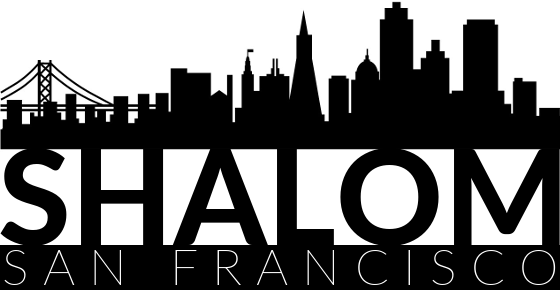
I drew it twice. The first concept set the words against the San Francisco skyline. The second is the one we used: a dove descending over the Golden Gate Bridge, with the dove's outstretched wings picking up the line of the suspension cables. One shape carrying both halves of the name.
We closed it in 2020.